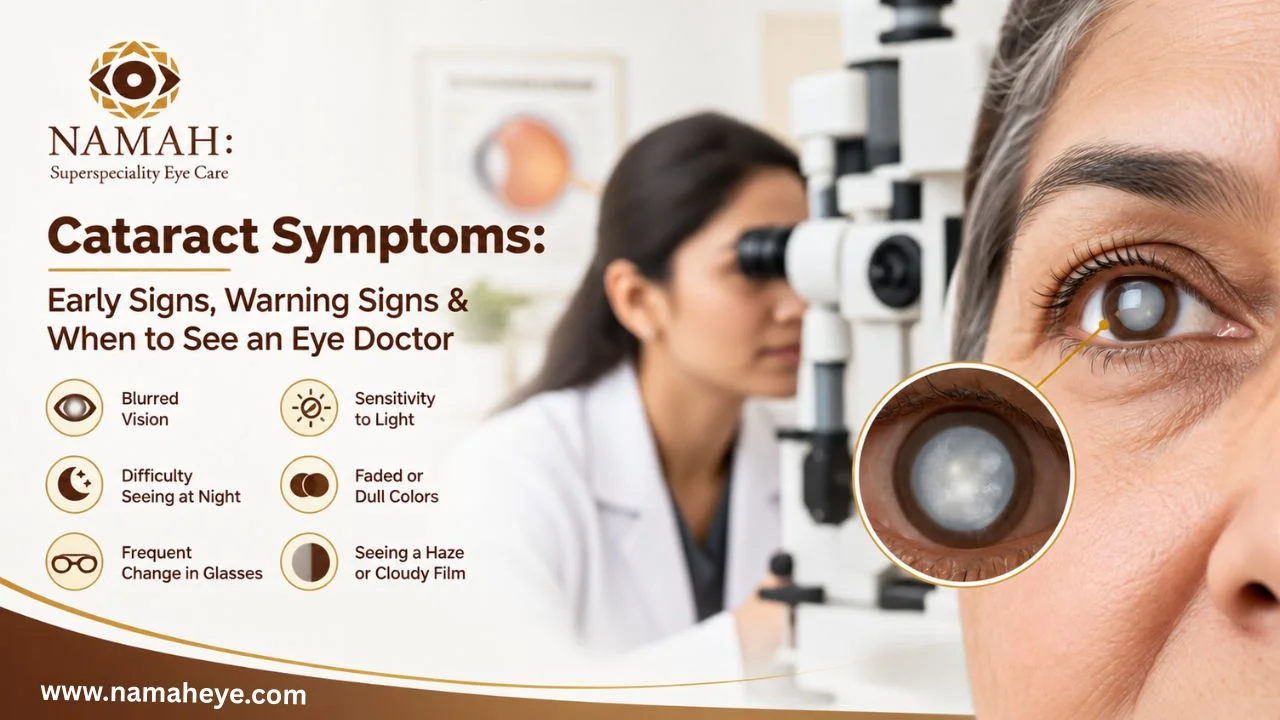
Cataract Symptoms: Early Signs, Warning Signs & When to See an Eye Doctor
Have you noticed that your vision is becoming blurry, cloudy, or less clear than before? Do bright lights feel uncomfortable, or has driving at night become more difficult?
These changes can sometimes be signs of cataracts.
A cataract develops when the natural lens inside the eye becomes cloudy. Since the lens plays an important role in focusing light and producing clear images, clouding of the lens can gradually affect your vision.
Cataracts usually develop slowly. In the beginning, the changes may be so mild that you hardly notice them. Over time, however, cataract symptoms can start affecting everyday activities such as reading, driving, using a mobile phone, watching television, or recognizing faces.
Knowing the early signs of cataract can help you understand when it may be time for an eye examination.
What Is a Cataract?
A cataract is a clouding of the eye’s natural lens.
Normally, the lens is clear and allows light to pass through it so that the retina can receive a sharp image. When a cataract develops, the lens becomes cloudy or less transparent.
As the cataract progresses, your vision may appear:
- Blurry
- Cloudy
- Hazy
- Dim
- Less sharp
- Less colourful
Cataracts are commonly associated with ageing, but they can also develop because of other risk factors, eye injuries, certain medical conditions, medications, or previous eye procedures.
What Are the Common Symptoms of Cataracts?
Cataract symptoms can be different for each person. Some people notice only mild changes, while others develop several symptoms as the cataract progresses.
1. Blurry or Cloudy Vision
Blurred vision is one of the most common cataract symptoms.
You may feel as though you are looking through a foggy or dirty window. Objects may no longer appear as sharp as they used to, even when you are wearing your glasses.
You may have difficulty:
- Reading books or newspapers
- Using your phone
- Watching television
- Recognizing faces
- Seeing distant objects
- Performing detailed work
If your vision continues to become blurry, an eye examination can help identify whether a cataract or another eye condition is responsible.
2. Difficulty Seeing at Night
Have you started finding night driving more difficult?
Cataracts can make it harder to see clearly in low-light conditions. You may struggle to identify objects in darker surroundings or feel that your vision is not as clear as it used to be after sunset.
Night-time driving can become particularly challenging when bright headlights create excessive glare.
3. Increased Glare and Light Sensitivity
Another common sign of cataract is increased sensitivity to bright light.
Sunlight, vehicle headlights, streetlights, or strong indoor lighting may appear much brighter or more uncomfortable than before.
You may notice this particularly while driving at night or moving from a dark environment into bright light.
4. Halos Around Lights
Do you see circles or glowing rings around headlights or other bright lights?
Seeing halos around lights can occur with cataracts and may become more noticeable in dark surroundings.
However, halos can also have other causes. If this is a new or persistent change in your vision, it is important to have your eyes examined.
5. Colours Appear Faded or Yellowish
Cataracts can gradually affect how you see colours.
You may notice that colours appear:
- Less bright
- Faded
- Dull
- Slightly yellowish
This change can happen so slowly that you may not recognize it immediately.
6. Frequent Changes in Glasses Power
If you find yourself changing your glasses prescription more often than usual, it may be worth having a complete eye examination.
Changes in vision can have many causes, and frequent prescription changes do not automatically mean that you have a cataract.
However, an examination can help determine whether the lens has started becoming cloudy or whether another condition is affecting your vision.
7. Difficulty Reading Even With Glasses
Do you need more light than before to read?
You may find yourself turning up the brightness on your phone, sitting closer to a lamp, or switching on additional lights while reading.
This can be one of the subtle early symptoms of cataract.
If reading has become increasingly difficult despite having the correct glasses, consider scheduling an eye examination.
8. Double Vision in One Eye
Cataracts can sometimes cause double vision or multiple images in one eye.
If you suddenly experience double vision, do not assume it is caused by cataracts. Double vision can have several possible causes and should be evaluated by an eye specialist.
What Do Early Cataract Symptoms Feel Like?
Cataracts generally develop gradually, so early symptoms can be easy to overlook.
You may simply feel that your vision is “not as clear as it used to be.”
Some people describe early cataract symptoms as:
- “Everything looks slightly cloudy.”
- “Night driving has become difficult.”
- “Bright lights bother my eyes.”
- “I need more light to read.”
- “Colours don’t look as bright.”
- “My glasses don’t seem to work as well as before.”
These symptoms can develop slowly and may initially seem like normal ageing.
However, persistent changes in vision should not be ignored.
Can Cataracts Cause Eye Pain?
Cataracts themselves usually do not cause eye pain.
If you experience sudden eye pain, sudden vision loss, severe redness, flashes of light, or a sudden increase in floaters, these symptoms should not simply be attributed to cataracts.
They may indicate another eye condition that requires prompt medical evaluation.
What Causes Cataracts?
Ageing is one of the most common factors associated with cataract development.
As we grow older, changes can occur in the proteins and structure of the natural lens, gradually making it cloudy.
Other factors that may increase the risk of cataracts include:
- Diabetes
- Smoking
- Previous eye injury
- Previous eye surgery
- Long-term corticosteroid use
- Family history of cataracts
- Prolonged exposure to ultraviolet light
- Certain medical conditions
Having one or more risk factors does not mean that you will definitely develop cataracts, but regular eye examinations can be helpful.
Who Is More Likely to Develop Cataracts?
Cataracts are more common as people get older, but they can affect people at different ages.
You may have an increased risk if you:
- Are older
- Have diabetes
- Smoke
- Have had a previous eye injury
- Have undergone certain eye surgeries
- Have a family history of cataracts
- Spend significant time exposed to sunlight without adequate eye protection
- Take corticosteroid medicines for a long period
When Should You See an Eye Doctor for Cataract Symptoms?
You should consider an eye examination if you notice persistent or worsening changes in your eyesight.
Some important signs include:
- Increasingly blurred vision
- Cloudy or hazy vision
- Difficulty seeing at night
- Increased glare
- Halos around lights
- Faded or yellowish colours
- Frequent changes in glasses prescription
- Difficulty reading
- Difficulty recognizing faces
- Double vision in one eye
You do not have to wait until your vision becomes severely affected before getting your eyes checked.
A comprehensive examination can determine whether cataracts are present and whether another eye condition may be causing your symptoms.
How Are Cataracts Diagnosed?
Cataracts are diagnosed through a comprehensive eye examination.
Depending on your symptoms and overall eye health, your doctor may assess:
- Visual acuity
- Glasses prescription
- The natural lens
- The retina
- The optic nerve
- Eye pressure
- Overall eye health
The examination helps determine whether your vision problems are related to cataracts or another eye condition.
This is important because blurred vision can have many causes.
Can Cataracts Be Treated?
Treatment depends on how much the cataract is affecting your vision and daily activities.
In the early stages, an updated glasses prescription, better lighting, or other simple adjustments may help you manage some symptoms.
When cataract-related vision changes begin interfering with everyday activities, your eye doctor may discuss cataract surgery.
During cataract surgery, the cloudy natural lens is removed and replaced with an artificial intraocular lens, commonly known as an IOL.
The timing of surgery depends on your symptoms, visual needs, overall eye health, and your doctor’s assessment.
Can Cataracts Be Prevented?
There is no guaranteed way to prevent every cataract, especially those related to ageing.
However, maintaining healthy eye and lifestyle habits may help reduce certain risk factors.
You can support your eye health by:
- Having regular eye examinations
- Managing diabetes and other health conditions
- Protecting your eyes from excessive UV exposure
- Avoiding smoking
- Maintaining a balanced diet
- Discussing long-term medication use with your doctor
Regular eye examinations are particularly important because they can detect cataracts and other eye conditions before vision problems become severe.
Cataract Symptoms vs Normal Age-Related Vision Changes
Many people assume that changes in eyesight are simply a normal part of getting older.
However, different eye conditions can produce similar symptoms.
For example, difficulty reading small print can occur with presbyopia, while cloudy vision, glare, halos, and difficulty seeing at night may occur with cataracts.
Other eye diseases can also cause blurred or distorted vision.
Therefore, it is better not to self-diagnose based on symptoms alone. A comprehensive eye examination can help identify the actual cause of your vision changes.
Conclusion
Cataract symptoms can develop gradually, which makes them easy to overlook. Blurry or cloudy vision, difficulty seeing at night, glare, halos around lights, faded colours, frequent prescription changes, and difficulty reading can all be signs that your eyes need professional evaluation.
Do not assume that every change in eyesight is simply part of ageing. A comprehensive eye examination can help identify whether you have a cataract and whether another eye condition may be contributing to your symptoms.
If you are experiencing cataract symptoms or changes in your vision, Namah Superspeciality Eye Care can provide appropriate eye evaluation and professional guidance based on your individual eye-health needs.