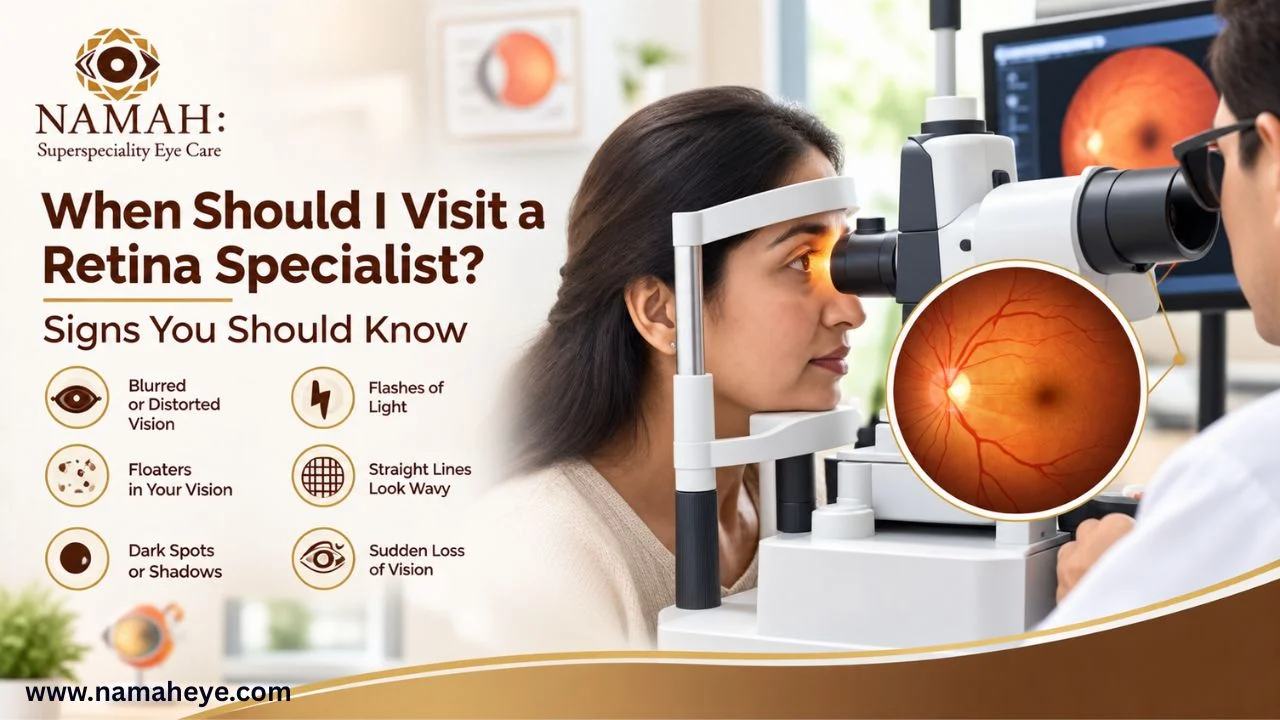
When Should I Visit a Retina Specialist? Signs You Should Know
Your eyes play an important role in everyday life, from reading and working to driving and recognizing faces. But not every eye problem is related to glasses or general eye power. Sometimes, changes in your vision can be linked to the retina and may need evaluation by a retina specialist.
So, when should you visit a retina specialist?
If you notice sudden flashes of light, new floaters, blurred vision, a curtain-like shadow, or sudden changes in your eyesight, you should get your eyes examined. People with diabetes, high myopia, age-related eye changes, or a history of certain eye problems may also need regular retinal check-ups.
Understanding the warning signs can help you know when it is time to seek specialist eye care.
What Is a Retina Specialist?
A retina specialist is an ophthalmologist who has additional training in diagnosing and treating conditions affecting the retina and vitreous.
The retina is a thin layer of tissue at the back of the eye. It receives light and sends visual information to the brain. Because the retina is essential for vision, problems affecting it can sometimes lead to serious changes in eyesight.
A retina specialist commonly evaluates conditions such as:
- Diabetic retinopathy
- Retinal detachment
- Retinal tears
- Macular problems
- Age-related macular degeneration
- Retinal bleeding
- Vitreous disorders
- Retinal vascular conditions
Depending on the condition, treatment may include monitoring, medication, injections, laser treatment, or surgery.
When Should I Visit a Retina Specialist?
Certain changes in your eyesight should not be ignored. Here are some situations when a retina consultation may be necessary.
1. You Suddenly See Flashes of Light
Have you started seeing flashes or brief streaks of light that were not there before?
Flashes can occur when the vitreous, the gel inside the eye, pulls on the retina. Sometimes, this can be associated with a retinal tear or retinal detachment.
If flashes are new, particularly if they occur frequently or suddenly, it is important to have your eyes examined.
Do not ignore new flashes, especially when they occur with floaters or changes in vision.
2. You Notice a Sudden Increase in Floaters
Floaters can look like tiny dots, lines, rings, or cobwebs moving across your vision.
Having a few floaters for a long time is common. However, suddenly seeing many more floaters can be a warning sign of a retinal problem.
New floaters may sometimes be associated with changes in the vitreous, retinal tears, or bleeding inside the eye.
If you suddenly notice a large number of floaters, arrange a prompt eye examination.
3. You See a Curtain or Shadow in Your Vision
A dark curtain, shadow, or missing area moving across your field of vision can be a warning sign of retinal detachment.
Retinal detachment occurs when the retina separates from its normal position inside the eye. It requires urgent medical attention because delayed treatment can result in permanent vision loss.
If you suddenly notice a curtain or shadow over your vision, seek emergency eye care immediately.
4. You Experience Sudden Blurred or Reduced Vision
Sudden blurred vision in one or both eyes should never be automatically considered a change in spectacle power.
Several eye conditions can cause sudden changes in vision, including problems involving the retina.
If your vision suddenly becomes unclear, significantly reduced, or distorted, an eye examination can help identify the underlying cause.
5. Straight Lines Start Looking Wavy
Look at a straight line, such as the edge of a window or door.
Does it suddenly appear bent or wavy?
This type of visual distortion can sometimes be related to problems affecting the macula, the central part of the retina responsible for detailed vision.
Macular problems can make everyday activities such as reading, using a mobile phone, or recognizing faces more difficult.
A retina examination can help determine whether the macula is affected.
When Should Diabetic Patients Visit a Retina Specialist?
Diabetes is an important risk factor for retinal problems.
High blood sugar levels can damage the small blood vessels in the retina, leading to a condition called diabetic retinopathy.
One of the biggest concerns with diabetic retinopathy is that it may develop without obvious symptoms in its early stages. You may feel that your vision is normal even when changes are taking place inside the eye.
For this reason, people with diabetes should have regular comprehensive eye examinations as advised by their eye specialist.
A retinal examination can help detect problems such as:
- Diabetic retinopathy
- Diabetic macular edema
- Retinal swelling
- Retinal bleeding
- Abnormal blood vessel growth
If you have diabetes and suddenly experience floaters, blurred vision, or reduced eyesight, seek medical attention promptly.
Do People With High Myopia Need Retina Check-Ups?
High myopia, or severe short-sightedness, can be associated with changes in the retina and may increase the risk of certain retinal conditions.
People with high myopia should discuss regular retinal examinations with their ophthalmologist.
A retina check-up becomes particularly important if you notice:
- New flashes
- Sudden floaters
- Blurred vision
- Distorted central vision
- A shadow or dark area in your eyesight
Regular monitoring can help your eye specialist identify changes that may require further attention.
Can Age Affect Retinal Health?
As we get older, the risk of certain retinal conditions can increase.
One condition associated with ageing is age-related macular degeneration (AMD). It affects the macula and can cause changes in central vision.
Possible symptoms include:
- Difficulty reading
- Difficulty recognizing faces
- Blurred central vision
- Straight lines appearing distorted
- A dark or missing area in central vision
If you notice new changes in your central vision, a retina specialist can examine your eyes and determine the possible cause.
What Happens During a Retina Examination?
Many people feel unsure about what happens during a retina consultation.
The examination usually begins with questions about your symptoms, medical history, previous eye problems, and any conditions such as diabetes.
Depending on your symptoms, the doctor may perform:
Vision Testing
Your vision is checked to understand how clearly you can see and whether there has been a change.
Dilated Eye Examination
Eye drops may be used to widen your pupils, allowing the doctor to examine the retina more clearly.
OCT Scan
Optical Coherence Tomography (OCT) is a non-invasive imaging test that creates detailed images of the retinal layers.
It can help assess conditions affecting the macula and retina, including retinal swelling and other structural changes.
Retinal Imaging
Additional retinal imaging may be recommended depending on your symptoms and examination findings.
These tests help the doctor understand what is happening inside the eye and decide whether monitoring or treatment is required.
Can Retinal Problems Be Treated?
Not every retinal condition requires surgery.
Treatment depends on the type of retinal problem, its severity, and the patient’s overall eye health.
Depending on the diagnosis, treatment may include:
- Regular monitoring
- Intravitreal injections
- Retinal laser treatment
- Vitreoretinal surgery
Some retinal tears may be treated with laser, while certain retinal diseases may require injections. More advanced conditions, including some cases of retinal detachment, may require surgery.
The right treatment can only be determined after a proper retinal examination.
When Is a Retina Problem an Emergency?
Some retinal symptoms require urgent medical attention.
Seek immediate eye care if you experience:
- Sudden flashes of light
- A sudden increase in floaters
- A curtain or shadow over your vision
- Sudden loss of vision
- Sudden peripheral vision loss
- Significant new distortion in your eyesight
These symptoms can sometimes indicate a retinal tear, retinal detachment, bleeding, or another eye condition requiring prompt evaluation.
Do not wait for these symptoms to disappear on their own.
Why Should You Not Ignore Retinal Symptoms?
Some retinal conditions can progress without causing obvious symptoms, particularly in the early stages.
This is especially important for people with diabetes and other retinal risk factors.
A regular eye examination can help detect retinal changes and allow your doctor to decide whether you need monitoring, treatment, or further investigation.
Even if your vision appears normal, regular eye check-ups can be an important part of maintaining long-term eye health.
Conclusion: When Should I Visit a Retina Specialist?
You should consider visiting a retina specialist if you experience new flashes, sudden floaters, blurred or reduced vision, a curtain-like shadow, or distortion in your eyesight.
People with diabetes, high myopia, age-related retinal concerns, or a history of retinal problems may also require regular retinal examinations.
The most important step is to not ignore sudden or unusual changes in your vision. Timely evaluation can help identify retinal problems and determine the appropriate treatment or follow-up.
For expert evaluation and specialized retinal care, consult Namah Superspeciality Eye Care and schedule a retina consultation based on your symptoms and eye-health needs.