
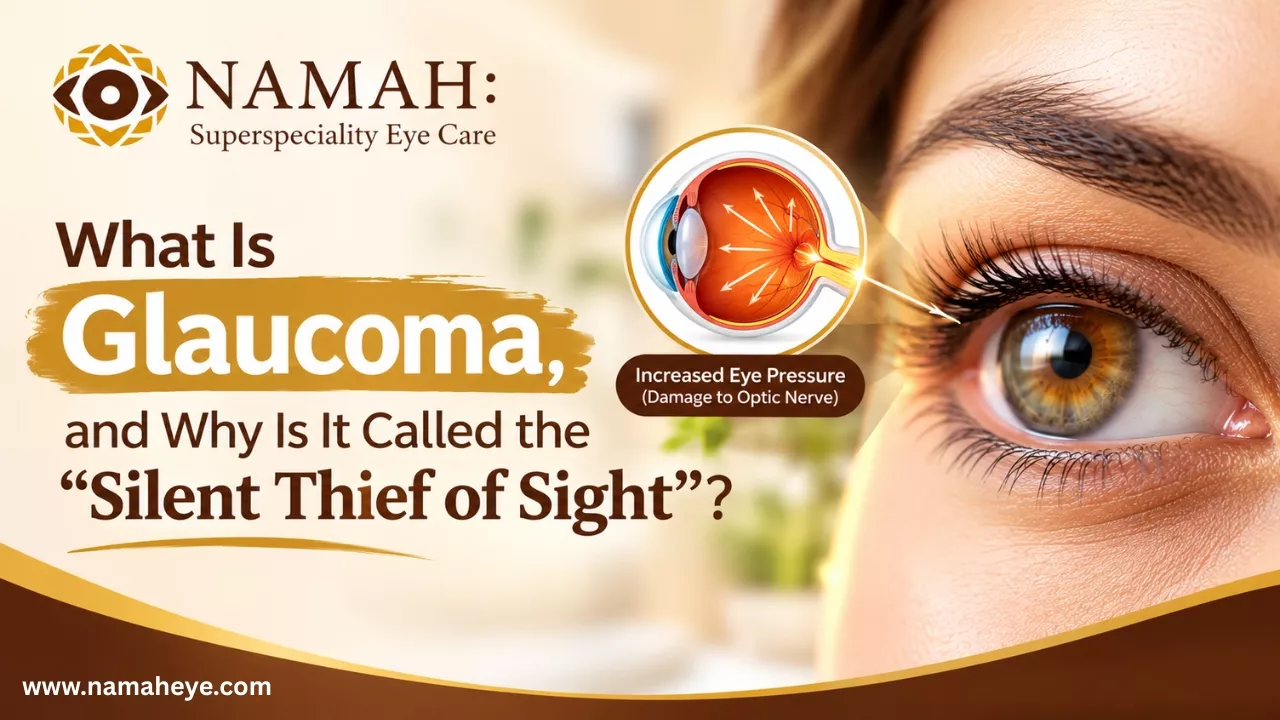
What Is Glaucoma, and Why Is It Called the “Silent Thief of Sight”?
Most thieves are loud. They break windows, trigger alarms and leave a mess. Glaucoma does none of that.
It comes in quietly and takes a little at a time, from the edges of your vision first, so slowly that your brain fills in the gaps and you carry on as usual. There is no pain, no redness and no blurry warning. By the time many people notice something is wrong, a large part of their sight is already gone, and what is lost cannot be brought back.
That is why eye specialists call glaucoma the “silent thief of sight.” This guide explains what it is, why it is so sneaky and what you can do to stay one step ahead.
What Is Glaucoma?
Glaucoma is not a single disease. It is a group of eye conditions that damage the optic nerve, the cable at the back of your eye that carries what you see to your brain.
Picture a high-speed internet cable between a camera and a computer. The camera (your retina) can work perfectly, but if the cable frays, the picture never arrives. Glaucoma frays that cable, one fibre at a time.
In many cases, the damage is linked to raised pressure inside the eye, called intraocular pressure (IOP). Your eye constantly produces a clear fluid that nourishes its front part and drains away through a tiny sponge-like channel. When drainage slows, pressure builds and presses on the optic nerve.
But pressure is not the whole story. Some people with high eye pressure never develop glaucoma, while others get it even with normal pressure. Researchers have not solved every part of the puzzle, which is one reason glaucoma remains a leading cause of irreversible blindness worldwide.
Why Is Glaucoma Called the “Silent Thief of Sight”?
Four reasons earn it the name:
- It starts without symptoms. In the vast majority of cases, early glaucoma causes no noticeable symptoms at all.
- It is painless. Most forms do not hurt, so there is no signal telling you to see a doctor.
- It steals side vision first. Your central vision stays sharp for a long time, so you read, watch TV and recognise faces normally while peripheral vision quietly fades.
- The damage is permanent. Unlike a cloudy cataract, lost glaucoma vision cannot be restored. Treatment can only protect what remains.
Imagine walking through a house where the lights go out one corner at a time. As long as you are looking straight ahead, you do not notice, until you bump into the furniture.
The Main Types of Glaucoma
1. Primary open-angle glaucoma (the most common)
The drainage channel looks open, but fluid drains too slowly, so damage develops gradually over years. This is the classic silent form, and a large share of people with it have above-average eye pressure, though not everyone does.
2. Angle-closure (narrow-angle) glaucoma
The drainage angle becomes narrow or blocked, causing pressure to rise, sometimes suddenly. An acute attack is an emergency.
3. Normal-tension glaucoma
The optic nerve is damaged even though eye pressure stays in the normal range.
4. Secondary glaucoma
Caused by another factor, such as eye injury, inflammation, certain medications or other eye conditions.
Symptoms: What You Might (and Might Not) Notice
Early open-angle glaucoma
- Usually nothing. That is the whole problem.
Advanced stages
- Patchy blind spots in your side vision
- Tunnel vision, like looking through a narrow tube
Acute angle-closure attack: seek emergency care immediately
- Severe eye pain
- Headache
- Red eye
- Nausea or vomiting
- Blurred vision
- Halos around lights
Important: Do not wait for symptoms. By the time glaucoma is noticeable, a significant amount of vision may already be lost.
Who Is at Higher Risk?
Glaucoma can affect anyone, but your chances go up if you:
- Are over 40, and especially over 60, since risk rises with age
- Have a parent or sibling with glaucoma. Family history is a powerful risk factor and can raise your risk many times over.
- Have high eye pressure
- Have thin corneas
- Have a high degree of nearsightedness or farsightedness
- Have diabetes or high blood pressure
- Have had an eye injury or eye surgery
- Have used steroid medicines for a long time, in drops, tablets or inhalers
- Belong to higher-risk ancestry groups, which vary by population
The more of these apply to you, the more important regular check-ups become.
How Is Glaucoma Detected?
Here is a crucial point: a glasses test or a quick vision check cannot detect glaucoma. It takes a comprehensive eye examination, usually including:
- Tonometry (eye pressure test). Measures internal eye pressure, either with a gentle air puff or a small instrument that lightly touches the numbed eye.
- Optic nerve examination. The doctor looks directly at the nerve for early signs of damage.
- Visual field test. You press a button whenever you see a flashing light, which maps your side vision and reveals blind spots you did not know you had.
- OCT scan (optical coherence tomography). A painless, radiation-free scan that creates detailed cross-section images of the optic nerve and retina layers.
- Gonioscopy. Checks whether the drainage angle is open or narrow.
- Corneal thickness measurement. Helps interpret pressure readings more accurately.
None of these tests hurts, and together they give your doctor a full picture.
Can Glaucoma Be Treated?
There is no cure, and no way to bring back vision that is already lost. But treatment can slow or stop further damage, and many people keep useful sight for life when glaucoma is caught early and managed well.
Eye drops
Usually the first step. They either reduce the fluid your eye produces or help it drain better. Using them every day, exactly as prescribed, is non-negotiable.
Oral medicines
Sometimes added when drops alone do not bring pressure down enough.
Laser treatment
Laser trabeculoplasty improves fluid drainage in open-angle glaucoma. Other laser procedures can open a narrow angle.
Surgery
- Filtering surgery creates a new drainage pathway
- Drainage tubes (shunts) carry excess fluid out of the eye
- Minimally invasive glaucoma surgery (MIGS) uses tiny devices and incisions and often has fewer side effects than traditional operations
Your specialist chooses the right path based on your type of glaucoma, the amount of damage and your overall health.
Habits That Help Protect Your Sight
- Book regular comprehensive eye exams, yearly or as advised if you have risk factors. Higher-risk people are generally advised to have a dilated exam every one to two years.
- Tell your family. If you have glaucoma, your parents, siblings and children should get checked too.
- Use your medication faithfully. Set a phone alarm if needed.
- Manage diabetes and blood pressure.
- Wear eye protection during sports and hazardous work.
- Discuss long-term steroid use with your doctor.
- Stay active and avoid smoking. Healthy habits support overall eye and circulatory health.
- Keep your follow-up appointments. Glaucoma needs lifelong monitoring.
Conclusion
So, what is glaucoma, and why is it called the silent thief of sight?
Glaucoma is a group of eye diseases that damage the optic nerve, often because of raised eye pressure. It earns its nickname because it sneaks in without pain or warning, steals side vision first and leaves behind damage that cannot be reversed.
The good news is that this thief can be caught. Remember these key points:
- Glaucoma usually has no early symptoms, so do not wait to “feel” something.
- A comprehensive eye exam is the only reliable way to detect it.
- Vision already lost cannot be restored, but treatment can protect what remains.
- Risk grows with age and family history, so check-ups matter even if you see well.
- Daily medication and regular follow-ups are what keep glaucoma under control.
- Sudden severe eye pain, redness, headache and nausea are an emergency.
You cannot hear this thief, and you cannot feel it. But you can stay ahead of it with a simple, painless eye check-up. A comprehensive glaucoma evaluation at Namah Superspeciality Eye Care can measure your eye pressure, assess your optic nerve and detect early changes, so that any problem is found while your sight is still easiest to protect.